FREE SHIPPING FOR ORDERS OVER €100 FOR GREECE


The Greek Komboloi: History, Tradition and Meaning
The History of the Greek Komboloi
The komboloi, although widely associated with Greek culture today, did not originally serve as a tool for prayer or meditation among the Greeks. Around the 10th century, in Mount Athos and other Orthodox monasteries, monks used a simple woolen cord with fifty-four knots, tied together in the form of a cross. This was called the prayer rope (komboskini) and was used for reciting prayers to the Virgin Mary. Some referred to it as a “prayer garland,” others as a “prayer rope,” while the term kombologion (later simplified as komboloi) emerged from the combination of the Greek words kombos (knot) and lego (to say), meaning “to say a prayer at each knot.”
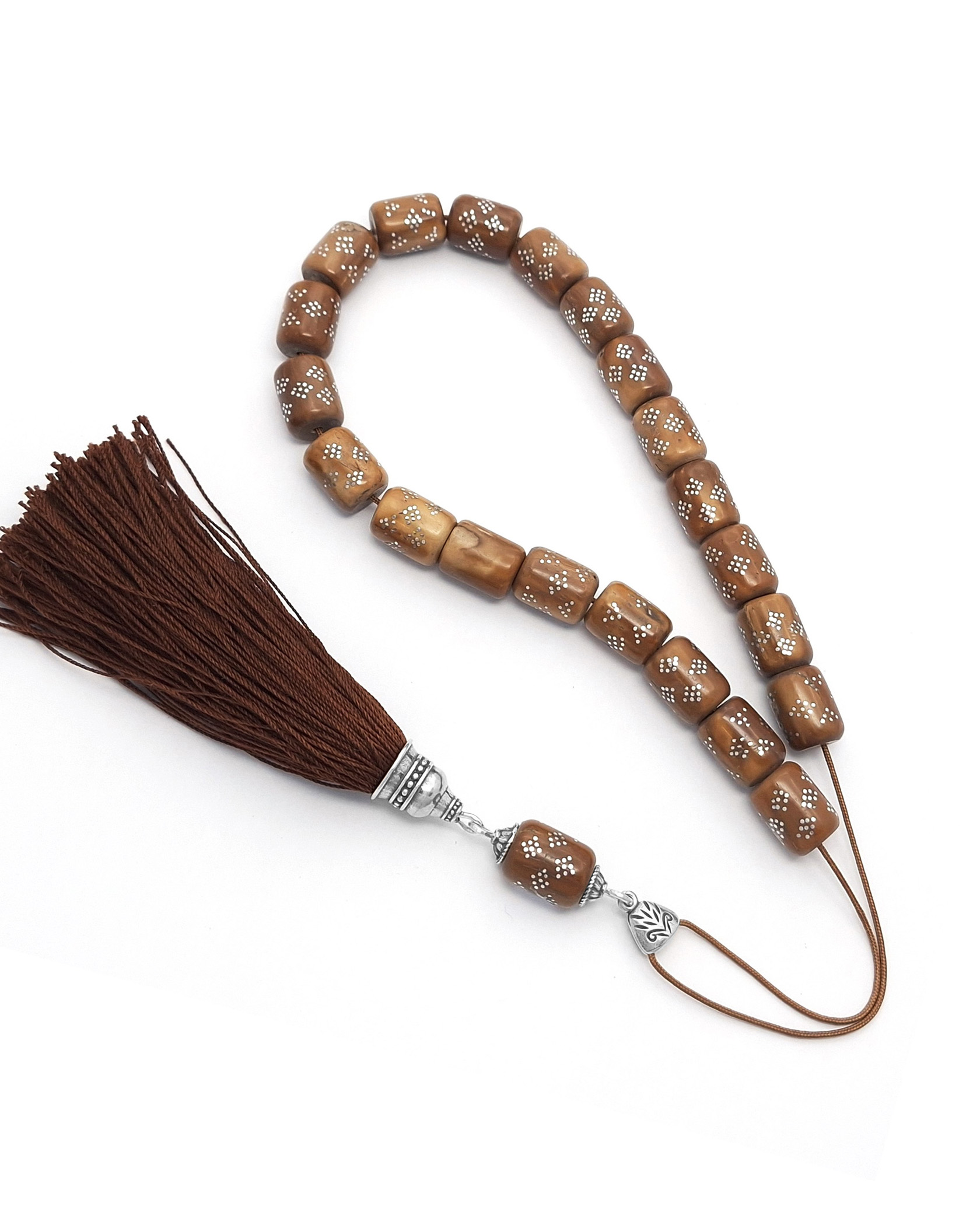
The form of the komboloi as we know it today entered Greece about five centuries ago, brought by the Ottomans. For them, the tesbih, a string of 33 or 99 beads often made of amber and ending in a silk tassel, symbolized prayer, authority, and luxury, while also functioning as a means of relaxation. During Ottoman rule, the tesbih was quickly adopted by local elites such as notables, landowners, and military leaders. Beyond its religious use, it gradually acquired new functions: a sign of friendship, a token of authority, even a symbol of masculinity and pride.
At the same time, Greek Orthodox believers, seeking comfort and strength through prayer, continued to use the prayer rope. This coexistence of the tesbih and the komboskini gradually led to a transformation. Many Greeks began replacing the knots of the prayer rope with beads, and the tesbih itself started being referred to as komboloi.
Several factors contributed to this evolution. Beads had greater weight, volume, and sound compared to simple knots, offering a richer sensory experience. Moreover, the tesbih allowed its users to express aesthetics, cultural identity, and social status through the choice of materials, colors, and craftsmanship. By the early 19th century and the time of the Greek War of Independence, the term komboloi had become firmly established, and the object had acquired a distinct Greek identity.
The ingenuity of the Greek people gave the komboloi a new cultural meaning. No longer limited to prayer, it became a beloved accessory, a symbol of leisure and style, and eventually an inseparable part of modern Greek tradition.
The Role of the Komboloi in Greek Society
From the 19th century onward, the perception of the komboloi shifted once again. People of different backgrounds began assigning their own interpretations to it, shaping its form and use according to personality, economic status, and aesthetic preferences. Thus emerged the secular or “cosmic” komboloi.
Unlike the monastic prayer rope or the Ottoman tesbih, the secular komboloi was no longer tied to religion. It was made with beads of various materials—amber, semi-precious stones, coral, silver, or gold—and its ending could feature a tassel, a large bead, a watch, or any other decorative element chosen by the owner.
These komboloia were often regarded as works of art. Their purpose was not loud clattering or ostentation but rather the gentle rhythm of touch, offering relaxation of the mind and body, focus, and even a meditative connection with one’s inner self. As such, the komboloi became at once a personal accessory, a symbol of refinement, and an object of aesthetic and emotional value.
Conclusion
The journey of the komboloi spans centuries and cultures, beginning in India with prayer beads, passing through Buddhism, Islam, and Christianity, and eventually taking root in Greece, where it was transformed into something entirely new. The Greek komboloi distinguished itself by transcending its religious origins and becoming a unique symbol of leisure, identity, and tradition.
From simple amber beads strung together during Ottoman times to today’s finely crafted komboloia made of silver, semi-precious stones, or even rare organic materials, each komboloi carries within it a story. It is a story of continuity and transformation, a reminder that tradition lives on not only in history books but in the rhythm of beads gently sliding through a hand.
© Eftehnon – The content of this article is protected by copyright. Sharing is permitted only with proper reference to the source.